sexta-feira, 29 de março de 2019

Thanks... But No Thanks Microsoft & Sony

I love technology, electronics and gaming. It's in my DNA... if it has a circuit board, chances are I like it! I've watched all the major keynotes (Apple, Microsoft, and Sony) and as it stands, I'm not going to purchase a console at or around launch. Granted this could all change in the months to come, at this point Microsoft and Sony have a hard sell ahead of them if they want my money this holiday season!

As a disclaimer, I make a living as a mobile games consultant on the NativeX Games Task Force. We collaborate with mobile game developers to increase the engagement, retention, and monetization of their freemium games. With that said, I am not biased towards mobile games, I'm simply not interested in the next generation consoles. Here's why:

Xbox One

I really like my Xbox 360. I wouldn't say I'm a fanboy, but I did initially buy an Xbox 360 over a PS3 because it was cheaper and out first. Sure I've owned 6-8 Xboxes since I had a first gen that broke, BUT we've had a great run together. Here are some reasons why this savvy consumer isn't buying an Xbox One at launch...

Price: Sure it's $100 more than the PS4, and I'd be willing to pay the extra amount IF it had features or games that I deemed worthy. The sad reality is that it does not.

Not Interested in Exclusives: I won't buy a console for an exclusive title. I think that's ridiculous. Maybe I'm just too practical, or maybe I'm not alone and more gamers/consumers are thinking like this?

Online Connection: While the internet is up 98% of the time at my house, I do feel a little anxious that it "requires" a connection at least once every 24 hours. What happens if I have an outage and want to play? I feel it's unacceptable that Microsoft might dictate when I can play... or where since I want the option to take my Xbox somewhere that might not have an internet connect. Come on Microsoft! Really?

Kinect: Maybe kids enjoy playing it? Honestly I haven't met someone who really, REALLY liked the Kinect. The most positive responses I get sound like "yeah it's ok" or "it's kind of cool." I'll spare you the slew of negative reactions. It has the same gimmicky feel that the Wii did, but without stellar and/or nostalgic IPs.

Hardware: It's early but I think benchmarks will be similar between the Xbox One and PS4. I certainly don't think I would tell a difference between the two if I played them side by side. This would be acceptable IF I weren't paying $100 more.

Skepticism of Microsoft First Gens: I got burned with my Xbox 360. I literally spent more time without an Xbox in the first year because of the dreaded red ring of death.  And what did I get for compensation? Nothing. Sure they sent me "new" (more accurately "other") Xbox's, but those broke too. I had 7 or 8 Xbox's before eventually buying a new one when the slimmer model came out, but only because my 8th Xbox broke again, I was outside of my "warranty" and I wanted to play with my brother in Japan.

After what I've been through I have every right to be bitter. I'm over it now, but in the heat of the moment I might've yelled at phone representatives or lost my cool. Fool me once Microsoft? Shame on you. Fool me twice? Not a chance in hell. :-)

PS4


I own a PS3 slim model as well as an Xbox 360. I play my 360 much more than my PS3 mostly due to Halo and the fact that my friends have Xboxes. If I had to buy a console today I would choose the PS4 over the Xbox One because what Sony is saying is appealing more to me, it's $100 less and will more likely support used game sales. However, there's one really big reason why I won't be buying a PS4 and that's the lack of need. Let me explain in the following areas...

No Hardware Upgrade Needed: Obviously this is personal, but the major reason why I won't buy a PS4 at launch. I don't "need" a new console. There's a reason why my TV isn't smart, 3D or 4k. I don't need those features. I'm also not buying a low end piece of crap from Wal-Mart, but I do my research, wait for the right deal and pull the trigger when it comes along. Sure the features mentioned might be nice to have, but as a consumer I don't buy nice to have features. I'm happy with my current generation consoles, their performance and will continue to play on them until there are games only for this generation and not my current 360/PS3.

No Vita: I, like most of you, don't have a Vita so the streaming functionalities doesn't matter to me. I also won't be buying another handheld gaming device because of the iPad and phones. In this day in age, with all our technological enhancements, there's no reason why I shouldn't be able to play any game I like on the platform of my choice. I know exclusives will never go away, but I wish they would. Call me crazy, but I just want to play what I want, where I want.

Here's an idea around streaming. Make an iOS & Android app that could stream content from my PS4 to my tablet. Join that with the ability to connect a PlayStation to Android devices and that iOS7 will have third party controller APIs. Console gaming + mobile capabilities = mind-blown!

Not Interested in Exclusives: Again, I won't buy a console for an exclusive title.

The Evolving World

I feel like these consoles aren't really listening to what's been happening in the technological world. It's a little old school to just "improve graphics" with a new generation of consoles. Sure they might've added TV/online capabilities, but I already have solutions in place to serve those needs so why would I need what they're selling?

It's true that my profession is within the mobile industry so you might be thinking he's just biased, but I assure you, there are reports how consoles and software sales are declining. Before you send me hate mail, or begin trolling with negative comments let me clarify something... I'm not saying consoles are doomed or dying! The NPD is primarily retail sales so it's possible that online sales are making up for the decline but there's no way to prove it since there's no insight on digital sales. I'm just saying that we live in a more innovative and immersive world. Our games and how we digest them need to be too. Sony won't top PS2 sales until they realize and embrace this.

These keynotes have left me a little depressed as a gamer. I've had launch consoles with every system since the SNES (minus the Dreamcast, which I owned, but not at launch). I want to be excited about the next generation of gaming, I want to be excited about buying a new piece of technology but as it stands now I can't get excited. Perhaps I'm the minority? Have I changed that much? Perhaps it's not you Microsoft/Sony... it's me? Things could change within the upcoming months, but I certainly need some crazy good reasons why I should even consider buying.

In the meantime I'll be right here Microsoft/Sony. Contently playing on my current generation of consoles... and of course on my iPad and iPhone...

If you'd like to talk about this or any other games you can find me here at my blog or on Twitter.

quinta-feira, 28 de março de 2019

How To Download Ps3 Emulator On Android

New ps3 Emulator for Android All Installation Information 


Sony PS3 Emulator is an Android emulator that simulates the Sony Play Station games to the Android phone. It's easy, just the install the app and follow the setup screen. Once the setup is finished, you can enjoy the games. But, since it's a cross-platform transformation, most of the may not work properly. Even if you have a high-end smartphone it might not work.

                            Screenshot


How to install ps3 Emulator Full Step

🔲 First Download ps3 Emulator For Any browser.
🔲 Then Search Which Foulde You Download ps3 Emulator.
🔲 Then Install ps3 Emulator For your Android.
🔲 After Installing ps3 Emulator you open ps3 Emulator Then View All Survey Finally Open ps3 Emulator.

Click All link Subscribe Channel And Like vidio Then Unlock Download Button


Zombie Of The Month: September 2015- Zombie Mime By Hasselfree Miniatures

March 22 has officially been deemed World Mime Day, in honor of legendary French mime artist Marcel Marceau. Of course, over here in zombie corner we prefer to celebrate someone's death day. Besides, what could be more appropriate for a mime than to celebrate his death? It is the ultimate expression of silence, after all. And so, in honor of the anniversary of Marcel Marceau's death on September 22, 2007, I bring you:

The Zombie of the Month- September 2015- Zombie Mime by Hasselfree Miniatures.


   What's so great about this zombie that he gets a whole month all to himself? Because, quite frankly, if you can't get a whole month's worth of entertainment out of a zombie mime, you're just not having enough fun with your zombie horde. The zombie mime is the ultimate zombie predator. Why? Because you never hear them coming. Think about it. You usually get some kind of warning- the typical zombie moan, the awkward shuffling of malformed feet. But the zombie mime retains his mime-performance instincts even in undeath. He is silent. He does not moan. He does not shuffle or trip. He moves with the grace and strength of someone who does not even need a real chair to be able to sit, even if he wanted to, which he doesn't have to now that he's a zombie. Your only prayer of escaping this ghastly menace is the hope that he will suddenly crash into an invisible wall while chasing you, thus giving you a head start.
   See, I told you a zombie mime was a ton of fun. I wish there were a whole set of them. I would buy them. And stat them as elite zombies with incredible camouflage and blind spot rules to adjust for their silent approach. As it is, I will probably pick up a second of these guys to convert with a floppy, pom-pom adorned top hat and paint him to look like Bip the Clown, Mr. Marceau's famous mime character. I didn't go with that for this one because the hat didn't match, and with his pose, with that paint scheme, you'd barely recognize him as a mime.


The Basics:

Scale- It looks like he's on the short end of 28 mm, since his total height is only 29mm.

Genre- Although various forms of mime and pantomime are nearly as old as human civilization, the modern French variation most people think of as mimes, the silent figure with a white face, was developed in the early 19th century, which means you can use them in anything from roughly the Victorian era to the modern day. Yeah, this guy is so showing up in Malifaux at some point.

Material- Metal- so don't drop him, or you'll totally ruin his routine when he clanks on the floor.

Parts 'N' Bits- Really? You're looking for extra bits with your zombie mime? Yeah, they're there, you just can't see them ::rolls eyes::

Assembly- No assembly required.

Bases- 30mm lipped slotted base included.


Ratings:

Sculpt- 3 brains out of 5- There's nothing terribly wrong with the sculpt, but it's not great, either. But really, people are only going to be looking at how well you paint the horizontal black and white stripes, anyway, so this one's on you as to whether it looks good.


Affordability- 2 brains out of 5- I've seen this mini go for as much as $10, but it shouldn't take much work to find it around $7. Still pricey for a single model, but sometimes the rare gem is worth it. If you're still hedging, see if you can tack it on to a bigger order so you won't feel the impact of the shipping charges.


Value- 5 brains out of 5- If a zombie mime is not an absolute must for your zombie horde, I feel sorry for you. Life clearly just does not hold enough magic for you.


Availability- 4 brains out of 5- Hasselfree Miniatures is a big company with a lot of distributors, so you shouldn't have too much trouble finding one.


Pros: They call high blood pressure the Silent Killer. I say it's this guy. For a mere $7 plus shipping you get to add one of the most terrifying zombies in all the apocalypse to your zombie horde, and good in multiple genres to boot. Who doesn't want that?

Cons: There's only one sculpt out there, so you can't have a squad of zombie mimes. Pitty.


Rest in Peace and Quiet, Mr. Marceau.


2019 Predictions In L&D... Some Surprising Disappearances...

Great survey from my friend and namesake Donald Taylor. We are sometimes confused (in both senses of the word), but when it comes to what's hot in workplace L&D in 2019, he's the go to man. This is the 6thyear of his survey, by nearly 2000 professionals making 5332 votes from 92 countries.

Top three stars

  Personalisation/adaptive learning (1)
  Artificial Intelligence (2)
  Learning Analytics (3)
One could argue that all three of these top spots have been taken by AI. Sure there are aspects of personalized learning and analytics that are not AI, but it's there, underlying all three top spots. I have spent the last four years saying that Artificial Intelligence is the major shift in learning technologies with a post in 2014, saying 'My tech prediction for 2015 - two small letters…AI'. AI is changing the very nature of work, so it is ridiculous to imagine that it will not also change why, what and how we learn. Having started this journey in AI many years ago, four years ago I made an investment in an adaptive learning company, started my own AI company WildFire and began talking about this at conferences all over the world. To ignore this is to ignore reality and arguably the most important technology shift we've seen since the invention of print.

Three newbies
  Microlearning (5)
  Learning Experience Platforms (6)
  Performance support (11)
I've grouped these together as they show an interesting shift in thinking towards the more dynamic delivery of learning. I'd link the to the top three as chatbots and other forms of smart AI delivery are helping them get to learners in the workflow. My fear is that we'll get a fair bit of puff, as people replace the M with an X and deliver the same old stuff.

Three media

  Virtual/augmented reality (7)  
  Mobile delivery (8)
  Video (13)
Characterised by the fact that they're actually hardware and media defined, they're here to stay. VR/AR is gaining ground, as I thought it would, and we have, at last, a way to deliver learning by doing. Mobile is, of course, everywhere and video is coming of age, as we're seeing it better integrated into learning.

Three business topics

  Consulting more deeply with the business (9)
  Showing value (10)
  Developing the L&D function (15)
Although all three dropped 5,4 and 3 places respectively, they're still in respectful positions and it's good to see the profession trying to keep business relevance and professionalism on the table. I'd like to see more attention to research and evidence but we're getting there.

Three bags full

  Collaborative learning (4)
  Neuroscience/cognitive science (12)
  Curation (14)
Collaborative learning is pretty solid, and it's good to see that the science of learning is still in here. I still find it shocking that many practitioners have no idea what science says about learning and online learning. Lastly curation – bit of an oddball this one but it's here.

Three goners

  Gamification
  MOOCs
  Badges
Gamification seems to have shot its bolt and disappeared. I think we got fed up with the weak side of gamification, playing Pavlov with learners, so it seems to have run its course. MOOCs have drifted away, more education that L&D – the numbers taking vocational MOOCS are phenomenal but this is not the world of L&D, it is the world of learners (oh the irony). Badges have also gone. That's a shame but I too changed my mind on these and they seem to have had their day.
Conclusion
Once again, a great insight into how people are thinking. Over the years this has been a pretty good guide to what's rising, staying around and falling. Well done to Donald Taylor and his team.

quarta-feira, 27 de março de 2019

Tokyo, Los Angeles, Bath, Hamburg!

Lots of exciting announcements, and a very busy end of the year ahead for this game developer!

Tokyo


This Thursday I'll be jetting my way to Japan for Tokyo Games Show. Codex Bash has been selected for the Indie Game Area and will be playable at booth A36 from 21 - 24 September.

Los Angeles


Then in October I'll be making my return to IndieCade in Los Angeles, where The Incredible Playable Show is an Official Selection. I'll be performing as part of the Night Games event on Saturday 7 October. I'll also be giving a talk about the creation of the show at 12 noon on Sunday 8 October.

Bath


Closer to home, I'll be performing The Incredible Playable Show in Bath as part of Bath Digital Festival, at 7pm on Tuesday 17 October. Entry is free with a festival ticket, which can be purchased here.

Hamburg


Finally, November sees me returning to PLAY Festival in Hamburg, where I'll be running The Incredible Playable Show from 2 - 4 November, in Markethalle Hamburg. I'll also be performing a special surprise skit at the opening party, for audience members who like to give their vocal cords a good workout!

terça-feira, 26 de março de 2019

Game 321: Star Control II: The Ur-Quan Masters (1992)

Let's not judge this one by its title screen . . .
               
Star Control II: The Ur-Quan Masters
United States
Toys for Bob (developer); Accolade (publisher)
Released in 1992 for DOS, 1994 for the 3DO console; later fan ports to other platforms
Date Started: 23 March 2019

When I started this blog in 2010, I had already played, at least in adolescence--most of the RPGs that everyone else knows. I may not have remembered all of the details, but I at least could remember the basic outlines of The Bard's Tale, Might and Magic, Wizardry, Questron, Pool of Radiance, and all of the Ultimas. There were lots of games I had never played--never even heard of--of course, but those were games that most other people my age had never encountered either. It wasn't until about a year into my blog, with Dungeon Master, that I truly felt I was blogging about a game that I should be ashamed for never having played previously.

For the first time since then, I am in that position again with Star Control II, a game that frequently makes "top X" lists of the best games of all time. My commenters have mentioned it so many times that my usual pre-game search of previous comments turned up too many results to analyze. This one, in other words, is really going to fill a gap.
       
. . . even though the first game had an awesome title screen.
        
There has been some debate about whether Star Control II is an RPG, but at least almost everyone agrees that its predecessor was not. That predecessor went by the grandiose name Star Control: Famous Battles of the Ur-Quan Conflict, Volume IV (1990), in an obvious homage to Star Wars. It's an ambitious undertaking--part simulator, part strategy game, part action game. The player has to manage ships and other resources and plan conquests of battle maps, but in the end the conflict always comes down to a shooting match between two ships using Newtonian physics and relying almost entirely on the player's own dexterity. This combat system goes back to Spacewar! (1962) and would be familiar to anyone who's played Asteroids (1979).

The setup has an Earth united under one government by 2025. In 2612, Earth is contacted by a crystalline race called the Chenjesu and warned that the Ur-Quan Hierarchy, a race of slavers, is taking over the galaxy. (Star Control II retcons this date to 2112.) Earth is soon enlisted into the Alliance of Free Stars and agrees to pool resources in a mutual defense pact. The Alliance includes Earth, the philosophic Chenjesu, the arboreal Yehat, the robotic Mmrnmhrm, the elfin Ariloulaleelay, and a race of all-female nymphomaniacs called the Syreen who fly phallic ships with ribbed shafts.

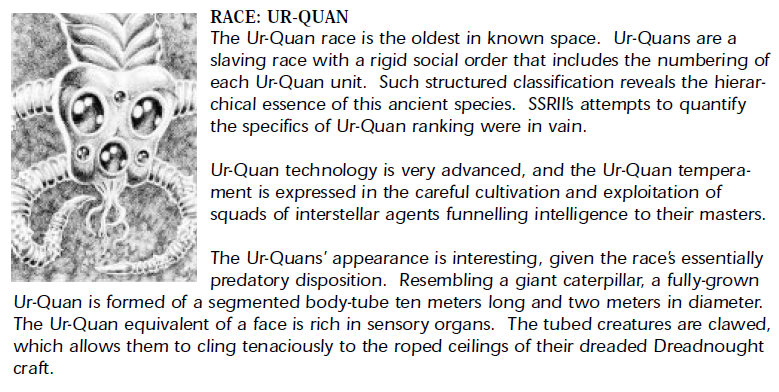
On the other side are the Ur-Quan, an ancient tentacled species with a strict caste system. They make slaves out of "lesser races" and only communicate with them via frog-like "talking pets." Their allies include Mycons, a fungus species; Ilwraths, a spider-like race that never takes prisoners; and Androsynths, disgruntled clones who fled captivity and experimentation on Earth. Each race (on both sides) has unique ship designs with various strengths and weaknesses, some of which nullify other ships. There's a kind-of rock-paper-scissors element to strategically choosing what ships you want to employ against what enemies.
          
No "bumpy forehead" aliens in this setting.
         
The occasionally-goofy backstory and description of races seems to owe a lot (in tone, if not specifics) to Starflight (1986), on which Star Control author Paul Reiche III had a minor credit. There are probably more references than I'm picking up (being not much of a sci-fi fan) in the ships themselves. "Earthling Cruisers" (at least the front halves) look like they would raise no eyebrows on Star Trek, and both Ilwrath Avengers (in the back) and Vux Intruders (in the front) look like Klingon warbirds. The Ur-Quan dreadnought looks passably like the Battlestar Galactica.

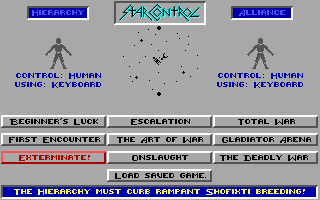
The original Star Control offers the ability to fight player vs. player or set one of the two sides to computer control (at three difficulty levels). In playing, you can simply practice ship vs. ship combat with any two ships, play a "melee" game between fleets of ships, or play a full campaign, which proceeds through a variety of strategic and tactical scenarios involving ships from different species in different predicaments.  The full game gives player the ability to build colonies and fortifications, mine planets, and destroy enemy installations in between ship-to-ship combats.
         
The various campaign scenarios in the original game.
      
The "campaign map" in the original game is an innovative "rotating starfield" that attempts to offer a 3-D environment on a 2-D screen. It takes some getting used to. Until they reach each other for close-quarters combat, ships can only move by progressing through a series of jump points between stars, and it was a long time before I could interpret the starfield properly and understand how to plot a route to the enemy.
         
Strategic gameplay takes place on a rotating starmap meant to simulate a 3-D universe.
             
I have not, in contrast, managed to get any good at ship combat despite several hours of practice. I'm simply not any good at action games. At the same time, I admire the physics and logistics of it. You maintain speed in the last direction you thrust even if you turn. You have limited fuel, so you can't go crazy with thrusting in different directions. You can get hit by asteroids, or fouled in the gravity wells of planets. And you have to be conservative in the deployment of your ships' special abilities, because they use a lot of fuel. Still, no game in which action is the primary determiner of success is going to last long on my play list. For such players, the game and its sequel offer "cyborg" mode, where technically you're the player but the computer fights your battles, but I'd rather lose than stoop to that.
             
One of my lame attempts at space combat.
          
Star Control II opens with a more personal backstory. In the midst of the original Ur-Quan conflicts, the Earth cruiser Tobermoon, skippered by Captain Burton, was damaged in an ambush and managed to make it to a planet orbiting the dwarf star Vela. As they tried to repair the ship, crewmembers found a vast, abandoned underground city, populated with advanced technology, built by an extinct race known as the Precursors.
        
The backstory is reasonably well-told with title cards.
      
Burton reported the find when she returned to Earth, and she was ordered to return with a scientific team led by Jules Farnsworth. Shortly after they arrived, they received word from Earth that the Ur-Quan had learned about the Precursor city and were on their way. Burton balked at Earth's orders to abandon and destroy the base with nuclear weapons. Instead, she sent her ship back to Earth under the command of her first officer and remained behind with the scientific team, planning to detonate nuclear weapons should the Ur-Quan ever arrive.
         
        
The team ended up spending 20 years on the planet, which they named Unzervalt, with no contact from Earth. During that time, the scientists discovered that the city had been created to build ships, and eventually they were able to activate the machines, which put together a starship. The machines shut down just as the ship was completed, reporting that there were insufficient raw materials to continue. About this time, Farnsworth admitted that he was a fraud, and all the success he'd experienced getting the machines up and running was due to a young prodigy born on Unzervalt--the player character.
         
They're not kidding about the "skeleton" part.
         
Burton assembled a skeleton crew for the new starship, with the PC manning the computer station, and blasted off. Three days out, they discovered the derelict Tobermoon, damaged and bereft of any (living or dead) crewmembers. Burton took command of the Tobermoon while the PC was promoted to captain of the new ship. Tobermoon was soon attacked and destroyed by an unknown alien craft, leaving the new ship to escape to Earth. Here the game begins.
         
What "plight"? You live on a technologically-advanced Eden where your enemies seem to have forgotten about you.
         
The player can name himself and his ship, and that's it for "character creation." He begins in the middle of the solar system, in a relatively empty ship with 50 crew and 10 fuel. I intuited that I needed to fly towards Earth, so I headed for the inner cluster of planets.  
            
"Character creation."
             
As the screen changed to show Mercury, Venus, Earth, and Mars, a probe zoomed out and attached itself to our ship. It played a recording from an Ur-Quan (with the "talking pet" doing the talking), informing me that approaching Earth was forbidden, as was my status as an "independent" vessel. The probe then zoomed off to inform the Ur-Quan of my "transgressions," leaving me to explore the planetary area at will. I guess the war didn't go so well for the Alliance.
            
Well, we now know how the first game ended, canonically.
        
As I approached Earth, the screen changed to show Earth, the moon, and a space station orbiting Earth. Earth itself seemed to have some kind of red force field around it, so I approached the space station.

As I neared, I was contacted by a "Starbase Commander Hayes of the slave planet Earth." He indicated that his energy cores were almost depleted and asked if we were the "Hierarchy resupply ship." At this point, I had a few dialogue options. One allowed me to lie and say I was the resupply ship. Another had me introduce myself. A third--more reflective of what I was actually thinking--said "'Slave planet?!' 'Hierarchy resupply vessel?!' What is going on here?'" The commander said he'd answer my questions if we'd bring back some radioactive elements to re-power the station. He suggested that we look on Mercury.
        
I like dialogue options, but so far they've broken down into: 1) the straight, obvious option; 2) the kind-of dumb lie; and 3) the emotional option that still basically recapitulates #1.
          
I flew off the Earth screen and back to the main solar system screen. At some point during this process, I had to delete the version of the game that I'd downloaded and get a new one. None of the controls worked right on the first one I tried. I particularly couldn't seem to escape out of sub-menus, which was supposed to happen with the SPACE bar. The second version I downloaded had controls that worked right plus someone had removed the copy protection (which has you identifying planets by coordinates). The controls overall are okay. They're much like Starflight, where you arrow through commands and then hit ENTER to select one. I'd rather be able to just hit a keyboard option for each menu command, but there aren't so many commands that it bothers me. Flying the ship is easy enough with the numberpad: 4 and 6 to turn, 8 to thrust, 5 to fire, ENTER to use a special weapon. There's a utility you can use to remap the combat commands, but using it seems to run the risk of breaking the main interface, which I guess is what happened with the first version I downloaded.
            
Running around Mercury and picking up minerals. The large-scale rover window (lower right) is quite small.
           
When orbiting a planet, you get a set of options much like Starflight. You can scan it for minerals, energy, or lifeforms, and then send down a rover (with its own weapons and fuel supply) to pick things up. Minerals are color-coded by type, and at first I was a little annoyed because I can't distinguish a lot of the colors. But it turns out that the explorable area of planets is quite small, and you can easily zoom around and pick up all minerals in just a few minutes. In that, it's quite a bit less satisfying than Starflight, where the planets were enormous and you'd never explore or strip them all, and you got excited with every little collection of mineral symbols. 

The rover doesn't hold much, but returning to the ship and then landing again is an easy process, so before long my hold was full of not just uranium and other "radioactives," but iron, nickel, and other metals. In mining them, the rover was periodically damaged by gouts of flame from the volatile planet, but it gets repaired when you return to the main ship.
        
Returning to base with a near-full cargo manifest.
         
We returned to the starbase and transferred the needed elements. With the station's life support, communications, and sensors working again, the captain was able to scan my vessel, and he expressed shock at its configuration. Rather than give him the story right away, I chose dialogue options that interrogated him first.
              
This seems to be everybody's reaction.
          
Commander Hayes explained that the Ur-Quan had defeated the Alliance 20 years ago. They offered humanity a choice between active serve as "battle thralls" or imprisonment on their own planet. Humanity chose the second option, so the Hierarchy put a force field around the planet, trapping the human race on a single world and preventing assistance from reaching them. But they also put a station in orbit so their own ships could find rest and resupply if they happened to pass through the system. The station is maintained by humans conscripted from the planet for several years at a time.
          
Humanity's fate didn't seem so bad until he got to this part.
          
When he was done, I (having no other choice, really) gave him our background and history and asked for his help. Pointing out that starting a rebellion and failing would result in "gruesome retribution," he asked me to prove my efficacy by at least destroying the Ur-Quan installation on the moon, warning me that I would have to defeat numerous warships.

We left the station and sailed over to the moon. An energy scan showed one blaze of power, so I sent the rover down to it. The report from the rover crew said that the alien base was abandoned and broadcasting some kind of mayday signal, "but great care has been taken to make it appear active." My crew shut the place down and looted it for parts.
           
My crew files a "report from the surface."
         
Lifeform scans showed all kinds of dots roaming around the moon, most looking like little tanks. I don't know if I was supposed to do this or not, but I ran around in the rover blasting them away in case they were enemies. I also gathered up all the minerals that I could.

I returned to the starbase, and the commander accepted my report. Just then, an Ilwrath Avenger, having found the probe, entered the system. The arachnid commander threatened us. There were some dialogue options with him, all of which I'm sure resulted in the same outcome: ship-to-ship combat.
           
They're not just "spider-like"; they actually spin webs on their bridges.
        
This part was much like the original game, although with the ship icons larger and against a smaller backdrop. I (predictably) lost the battle the first two times that I tried, but won the third time. In my defense, the game's backstory specifically said that I had minimal weapons. It was also a bit lumbering--slow to turn, slow to thrust.
         
The alien ship destroys me in our first encounter.
       
When I returned to starbase after the battle, Commander Hayes said he would join my rebellion, and the starbase would be my home base. He asked what we would call our movement, and there were some amusing options.
           
The last option tempted me, but I was boring and went with the first one.
           
Through a long series of dialogues, I learned that as I brought back minerals and salvage, the base could convert them into "resource units" (RU) which I could then use to build my crew, purchase upgrades for the Prydwen (improved thrusters, more crew pods, more storage bays, more fuel), get refueled, and build a fleet of starships. I can even build alien ships if I can find alien allies to pilot them.
         
My own starbase. Why can't I name it?
         
Hayes had a lot more dialogue options related to history and alien species, but I'll save those for later. It appears that the introduction is over and I now have a large, open universe to explore, where I'm sure I'll do a lot of mining, fighting, and diplomacy. In this sense, Star Control II feels like more of a sequel to Starflight than the original Star Control.
            
One part of a nine-page starmap that came with the game. I'm tempted to print it out and assemble it on the wall in front of my desk. I suppose it depends on how long the game lasts.
         
I appreciate how the game eased me into its various mechanics. I'm enjoying it so far, and I really look forward to plotting my next moves. I suspect I'll be conservative and mine the rest of the resources in the solar system and buy some modest ship upgrades before heading out into the greater universe.

Time so far: 2 hours


New Computer

I used my last computer from 2006 until last week. It was serviceable, given that it was a slapdash affair when I put it together - a barebones system with cannibalized parts from my previous computer, which suddenly stopped working (in retrospect, it was likely the power supply, the one thing I didn't check at the time). Anyway, the last computer got me through Bioshock, Fallout 3, Left 4 Dead 2, and more, surprisingly given that it was probably something like 2004's finest. But it wouldn't run Dragon Age: Origins, or Fallout: New Vegas, and in the straw that broke the camel's back when I was offered a review copy, Shogun 2: Total War. My hard drive was also filled to the brim, and my wireless flaky as hell. With my tax return showing a decent amount of numbers, it was time to treat myself.

I had a few things to consider, and they didn't all work together well. At all. First, I wanted something energy efficient, in order to soothe my bleeding heart, and hopefully not destroy my electricity bill either. I'd also have preferred to have parts not made from blood cadmium or whichever, but that's unfortunately far too difficult to research. On the other hand, I wanted power - enough to play new games for three years or so. Happily, the rate of technology has slowed down over the last decade, so this is actually pretty possible to do. More good news - newer technology in chips and in video cards indicates that they're actually better than previous models at lower power usage, even when they're more powerful overall, because they do a better job of lowering energy using when not being used at full force.

Of course, the bigger issue is money. I didn't get that big of a tax return. Unfortunately, since the newest of those more-efficient pieces of hardware had the best efficiency, I'd have to figure out how much money to spend on bleeding-edge stuff now, which is "not very much." I also wanted to avoid doing too much computer-building, since that can be a pain in the ass, but I left it as an option.

I'm happy that I did keep that option open, because I cut probably 20% of the cost out, and was able to research my parts directly. Here are my specs:

Operating System: Windows 7 Home Premium 64-bit
Motherboard: MSI MS-7642
Processor: AMD Phenom(tm) II X4 955 Processor (4 CPUs), ~3.2GHz
Memory: 4096MB RAM
Video Card: ATI Radeon HD 5670
Video Card Display Memory: 2295 MB
Video Card Dedicated Memory: 503 MB
Sound Card: Creative SB Audigy 2 ZS*
Total Space: 476.8 GB
Hard Drive Model: WDC WD5002AALX-00J37A0 ATA Device
CD-ROM Model: _NEC DVD_RW ND-3550A ATA Device*
*cannibalized from older computer

All this was roughly $600. (though I also picked up Windows 7 and some accessories). No new monitor, though, and my current one maxes out at 1240x1040, so I'm not getting the very best resolution. But everything seems to be running well, Shogun 2 is a blast (my AV Club review is coming soon). I hope that this allows me to get more directly into reviews and discussions of current-generation PC games - and lets me play the best mods for the ones which have been out for a while.

Let’S Talk About Policy! Resources Available For You To Understand Adsense Policies.


Thanks to your feedback around wanting us to be more transparent and clear in our policy communications, we will be tackling a policy topic each week directly from our AdSense YouTube channel in a series called "Let's talk about Policy!".

Last week we looked at the role of policy in the ads eco-system to gain an understanding into why we need policies and who benefits from them, this week we're talking about the various resources available to you to understand the policies. Those resources include:


So you can choose to learn & understand our policies across the platform that suits you best.


Remember that after each video goes live, we will be on hand to answer your questions related to the topic for a few hours. So be sure to subscribe to the channel to ensure you don't miss an episode. 

Posted by:
The AdSense Team 


sábado, 23 de março de 2019

ouo.io - Make short links and earn the biggest money


Shrink and Share

Signup for an account in just 2 minutes. Once you've completed your registration just start creating short URLs and sharing the links with your family and friends.
You'll be paid for any views outside of your account.

Save you time and effort

ouo.io have a simple and convenient user interface, and a variety of utilities.
We also provides full mobile supports, you can even shorten the URL and view the stats on a mobile device.


sexta-feira, 29 de junho de 2018

Top 12 Best Highest Paying URL Shortener Sites to Make Money Online

  1. ADmy.link

    ADmy.link is also one of the best URL sites.It is a trusted site.You can earn simply by registering for an account.It's fast and free!then you can Find URLs you would like to monetize and shorten your links.You just have to Share your shortened links and drive traffic to your content.
    Then Earn money by sharing in the advertising revenues for each real visit to your links!You can earn $5 for 1000 views.Minimum payout is $5.You can earn extra money by their referral system.They offer 15% as a referral program.
    • Payout for 1000-$5
    • Minimum payout-$5
    • Referral commission-15%
    • Payment method-PayPal
    • Payment time-start of every month.

  2. Linkbucks

    Linkbucks is another best and one of the most popular sites for shortening URLs and earning money. It boasts of high Google Page Rank as well as very high Alexa rankings. Linkbucks is paying $0.5 to $7 per 1000 views, and it depends on country to country.
    The minimum payout is $10, and payment method is PayPal. It also provides the opportunity of referral earnings wherein you can earn 20% commission for a lifetime. Linkbucks runs advertising programs as well.
    • The payout for 1000 views-$3-9
    • Minimum payout-$10
    • Referral commission-20%
    • Payment options-PayPal,Payza,and Payoneer
    • Payment-on the daily basis

  3. Clk.sh

    Clk.sh is a newly launched trusted link shortener network, it is a sister site of shrinkearn.com. I like ClkSh because it accepts multiple views from same visitors. If any one searching for Top and best url shortener service then i recommend this url shortener to our users. Clk.sh accepts advertisers and publishers from all over the world. It offers an opportunity to all its publishers to earn money and advertisers will get their targeted audience for cheapest rate. While writing ClkSh was offering up to $8 per 1000 visits and its minimum cpm rate is $1.4. Like Shrinkearn, Shorte.st url shorteners Clk.sh also offers some best features to all its users, including Good customer support, multiple views counting, decent cpm rates, good referral rate, multiple tools, quick payments etc. ClkSh offers 30% referral commission to its publishers. It uses 6 payment methods to all its users.
    • Payout for 1000 Views: Upto $8
    • Minimum Withdrawal: $5
    • Referral Commission: 30%
    • Payment Methods: PayPal, Payza, Skrill etc.
    • Payment Time: Daily

  4. Ouo.io

    Ouo.io is one of the fastest growing URL Shortener Service. Its pretty domain name is helpful in generating more clicks than other URL Shortener Services, and so you get a good opportunity for earning more money out of your shortened link. Ouo.io comes with several advanced features as well as customization options.
    With Ouo.io you can earn up to $8 per 1000 views. It also counts multiple views from same IP or person. With Ouo.io is becomes easy to earn money using its URL Shortener Service. The minimum payout is $5. Your earnings are automatically credited to your PayPal or Payoneer account on 1st or 15th of the month.
    • Payout for every 1000 views-$5
    • Minimum payout-$5
    • Referral commission-20%
    • Payout time-1st and 15th date of the month
    • Payout options-PayPal and Payza

  5. Adf.ly

    Adf.ly is the oldest and one of the most trusted URL Shortener Service for making money by shrinking your links. Adf.ly provides you an opportunity to earn up to $5 per 1000 views. However, the earnings depend upon the demographics of users who go on to click the shortened link by Adf.ly.
    It offers a very comprehensive reporting system for tracking the performance of your each shortened URL. The minimum payout is kept low, and it is $5. It pays on 10th of every month. You can receive your earnings via PayPal, Payza, or AlertPay. Adf.ly also runs a referral program wherein you can earn a flat 20% commission for each referral for a lifetime.
  6. Shink.me

    Shink.me is one of the old URL shortener sites.It is a legit site.You just have open an account free.You can earn from this like other URL shortener companies.It offers the good CPM rate for all countries traffic.
    You can earn $4.65 for every 1000 views.The minimum payout rate is $5.ther offer 10% referral commission.PayPal and Payza are payment methods of shink.me.
    • The payout for 1000 views-$4.65
    • Minimum payout-$5
    • Referral commission-10%
    • Payout methods-Payza and Paypal
    • Payment time-Biweekly

  7. BLV.ME

    BLV.ME is one of the most trusted URL shortener sites.It pays high CPM rate.You can earn $10 for every 1000 views.One worst thing about blv.me is its referral system.
    They only offer 5% referral commission which is very much low.You can withdraw your amount when it reaches $10.You can claim your amount through Payza, Bank Transfer or Skrill.
    • The payout for 1000 views-$10
    • Minimum payout-$10
    • Referral commission-5%
    • Payout options-Payza, Skrill, and bank transfer
    • Payment time-at the end of the month

  8. Shorte.st

    Shorte.st is another very popular and most trusted URL Shortening Company. Shorte.st comes as a user-friendly URL Shortener Service with many creative options for making money by monetizing the links you share. Shorte.st provides you an opportunity to earn from $5 to $15 per 1000 views for promoting their shortened links.
    For WordPress Bloggers, Shorte.st brings its WordPress Plugin which will help you greatly to boost your earnings. Shorte.st has a low minimum payout of $5.
    The payment is credited automatically on the 10th of each month. The payment methods include PayPal, Payoneer, and WebMoney. It also presents a referral earning opportunity wherein you can earn 20% commission on referrals for a lifetime.
  9. LINK.TL

    LINK.TL is one of the best and highest URL shortener website.It pays up to $16 for every 1000 views.You just have to sign up for free.You can earn by shortening your long URL into short and you can paste that URL into your website, blogs or social media networking sites, like facebook, twitter, and google plus etc.
    One of the best thing about this site is its referral system.They offer 10% referral commission.You can withdraw your amount when it reaches $5.
    • Payout for 1000 views-$16
    • Minimum payout-$5
    • Referral commission-10%
    • Payout methods-Paypal, Payza, and Skrill
    • Payment time-daily basis

  10. Linkshrink

    Linkshrink URL Shortener Service provides you an opportunity to monetize links that you go on the Internet. Linkshrink comes as one of the most trusted URL Shortener Service. It provides an advanced reporting system so that you can easily track the performance of your shortened links. You can use Linkshrink to shorten your long URL. With Linkshrink, you can earn anywhere from $3 to $10 per 1000 views.
    Linkshrink provides lots of customization options. For example, you can change URL or have some custom message other than the usual "Skip this Ad" message for increasing your link clicks and views on the ad. Linkshrink also offers a flat $25 commission on your referrals. The minimum payout with Linkshrink is $5. It pays you through PayPal, Payza, or Bitcoin.
  11. Petty Link

    Shorten URLs and earn money with Petty Link which is one of the best URL Shortening for earning money online.
    Getting started is easy. You need to create an account, shorten your link, and start earning money. Petty is one of the best ways to earn extra money.
    You get to make money from home when managing and protecting your link. Using the Petty Link tool, you can create short links. What's best, you get paid. It's a completely free tool.
    You have to create an account, create a link, and post it. For every visit, you earn money. The payout is as much as $12 per 1000 views. Plus, you can get 21% Referral Bonus.
    It has the Petty Link Referral Program. Refer friends and receive 21% of their earnings for life.
    Its featured Administration Panel allows you to control all of the features with a click of a button. It offers detailed stats. You get to know your audience.
    It has a low minimum payout. You need to earn only $5.00 before you are paid. Payment method is PayPal. Moreover, Petty offers the highest rates.
    Plus, it has a dedicated support team to help you out in case you have any questions or issues.
  12. Short.am

    Short.am provides a big opportunity for earning money by shortening links. It is a rapidly growing URL Shortening Service. You simply need to sign up and start shrinking links. You can share the shortened links across the web, on your webpage, Twitter, Facebook, and more. Short.am provides detailed statistics and easy-to-use API.
    It even provides add-ons and plugins so that you can monetize your WordPress site. The minimum payout is $5 before you will be paid. It pays users via PayPal or Payoneer. It has the best market payout rates, offering unparalleled revenue. Short.am also run a referral program wherein you can earn 20% extra commission for life.

quinta-feira, 28 de junho de 2018

Top 9 Websites to Learn How to Hack Like a Pro

  1. KitPloit: Leading source of Security Tools, Hacking Tools, CyberSecurity and Network Security.
  2. Exploit DB: An archive of exploits and vulnerable software by Offensive Security. The site collects exploits from submissions and mailing lists and concentrates them in a single database.
  3. HackRead: HackRead is a News Platform that centers on InfoSec, Cyber Crime, Privacy, Surveillance, and Hacking News with full-scale reviews on Social Media Platforms.
  4. Hakin9: E-magazine offering in-depth looks at both attack and defense techniques and concentrates on difficult technical issues.
  5. Metasploit: Find security issues, verify vulnerability mitigations & manage security assessments with Metasploit. Get the worlds best penetration testing software now.
  6. Packet Storm: Information Security Services, News, Files, Tools, Exploits, Advisories and Whitepapers.
  7. Hacked Gadgets: A resource for DIY project documentation as well as general gadget and technology news.
  8. The Hacker News: The Hacker News — most trusted and widely-acknowledged online cyber security news magazine with in-depth technical coverage for cybersecurity.
  9. Phrack Magazine: Digital hacking magazine.

segunda-feira, 13 de fevereiro de 2017